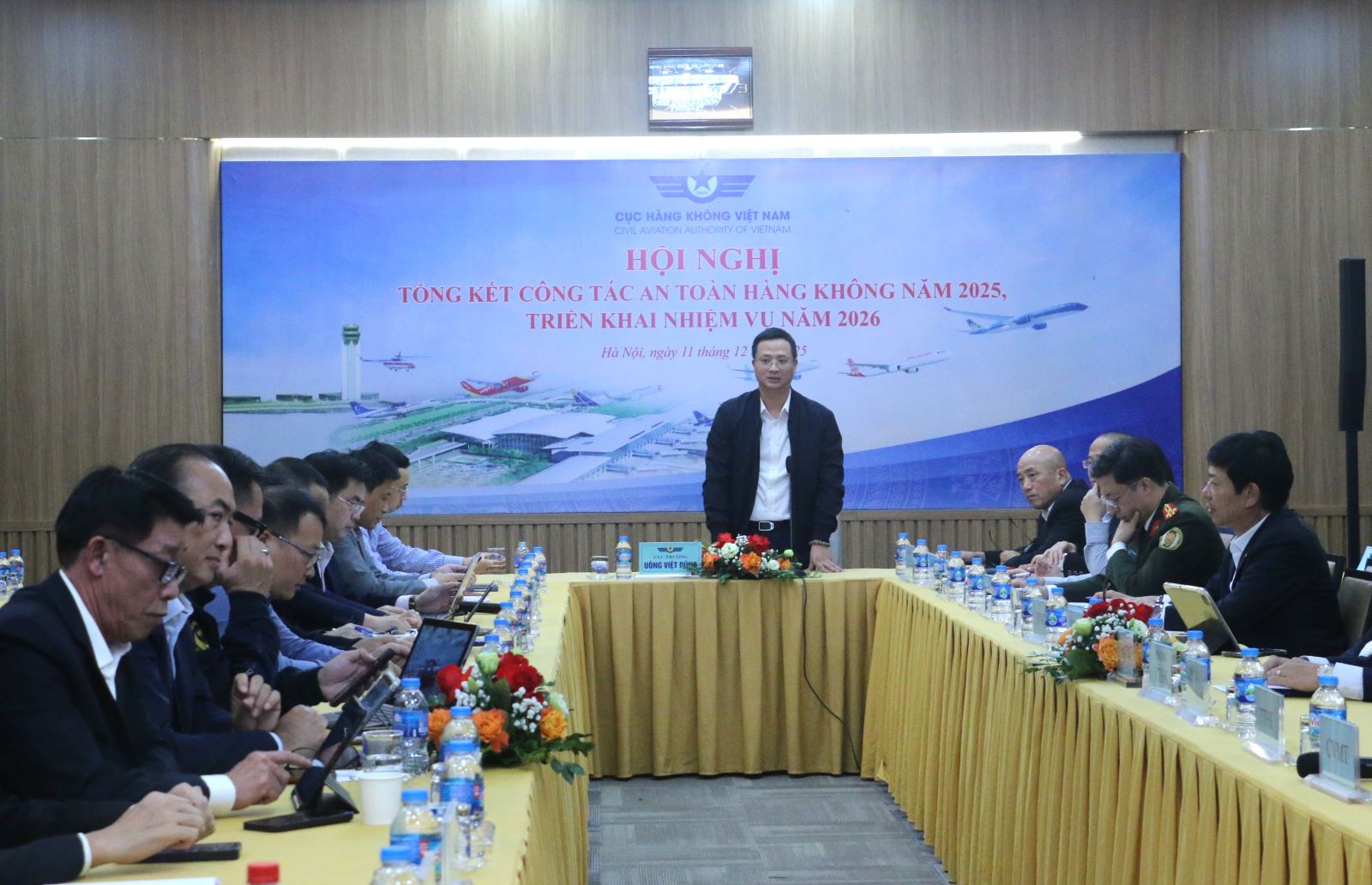
Director General of the Civil Aviation Authority of Vietnam, Uong Viet Dung, speaks at the Conference.
Speaking at the Conference, Director General of the Civil Aviation Authority of Vietnam, Uong Viet Dung, stated that the National Assembly recently officially passed the amended Law on Civil Aviation of Vietnam. The Law includes a Chapter on aviation safety.
According to the Director General of the Civil Aviation Authority of Vietnam (CAAV), this is an important legal framework to issue and develop national aviation safety and security programs, and to implement aviation safety programs.
Dung asked delegates to focus on comprehensively evaluating the achievements, frankly point out shortcomings and limitations, and propose specific solutions and recommendations to improve the quality of aviation safety work in the coming period.
Positive results recorded in aviation safety assurance
According to reports presented at the Conference, in 2025 the operational activities of Vietnamese airlines continued to show growth, with transport volumn increasing compared to 2024. Specifically, passenger volume rose by 6.7% and cargo volume increased by 4.6% compared to the same period in 2024.
In 2025, Vietnam’s aviation sector still faced a number of challenges. In addition, the year saw many periods of storms, fog, and strong convective clouds at key airports, causing temporary disruptions and placing significant pressure on aviation operations.
In this context, air transport operations remained safe and stable, especially during peak periods such as the Lunar New Year, summer peak, and major national celebrations such as A50 and A80. Safety oversight was strictly implemented at all airports nationwide.
The Civil Aviation Authority of Vietnam (CAAV) has also announced the National Aviation Safety Plan (NASP) for the 2025-2028 period, in compliance with the Global Aviation Safety Plan (GASP) of the International Civil Aviation Organization (ICAO) and the Asia-Pacific Regional Aviation Safety Plan (AP-RASP). This plan incorporates corrective action plans addressing the ICAO USOAP recommendations for Vietnam issued in 2024.
Through aviation safety oversight activities, the CAAV has identified a number of existing issues in the operations of the aviation sector.
At the same time, the Authority closely monitors factors affecting aviation safety, identifies potential risks that may threaten safety, and implements measures to ensure aviation safety.
Specifically, the leadership of the CAAV has issued a series of directives on enhancing aviation safety assurance; strengthening safety measures for air traffic control systems and equipment; reinforcing flight safety under adverse weather conditions; improving operational safety for ground vehicles operating at Tan Son Nhat International Airport; and developing and enhancing the effectiveness of air transport operations.
At the same time, the Authority has decisively implemented action programs, monitored progress, and instructed agencies and units to strictly comply with Directive No. 21/CT-TTg dated August 12th, 2025, on strengthening measures to ensure aviation safety and security, with periodic reporting on implementation results.
One of these issues is that aviation personnel have not fully complied with standard operating procedures across various fields. Failure to follow standard procedures has led to situations such as the risk of aircraft-to-aircraft collisions, ground vehicle-to-aircraft collisions, equipment damage during maintenance, and violations of aircraft separation standards.
The CAAV has also required airlines to proactively assess risks and increase minimum operating limits at airports to ensure safe operations under adverse weather conditions; required the Airports Corporation of Vietnam (ACV) to deploy automatic runway surface water depth measurement equipment in order to promptly provide information to pilots; and required the Vietnam Air Traffic Management Corporation (VATM) to enhance the quality of weather forecasts and warnings in support of flight operations.
Based on the decisive implementation of safety enhancement measures by the Civil Aviation Authority of Vietnam (CAAV) and the coordination and efforts of aviation enterprises and personnel, Vietnam’s aviation sector recorded positive results in aviation safety assurance in 2025, with safety indicators improving, particularly in terms of human error.
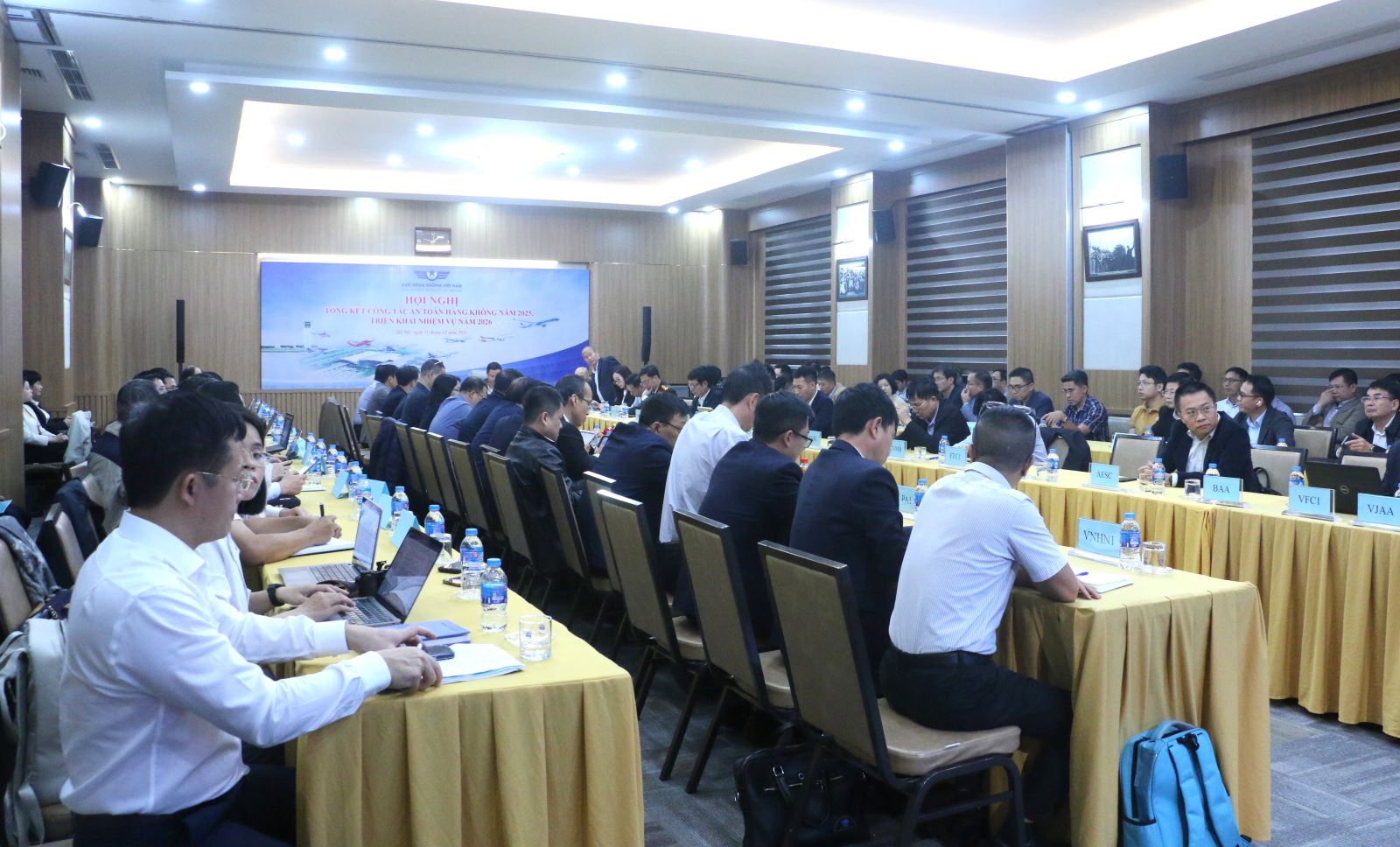
Delegates were at the conference.
Ensuring absolute aviation safety
Regarding the orientation and tasks for 2026, the Civil Aviation Authority of Vietnam (CAAV) has requested agencies and units to continue decisively implementing measures to ensure aviation safety. In particular, resources will be focused on reviewing and developing a system of guiding documents for the implementation of the (revised) Law on Civil Aviation of Vietnam.
Agencies and units will continue to review, propose, amend, and supplement relevant legal normative documents in order to complete the stable legal framework for civil aviation operations and meet the development requirements of Vietnam’s civil aviation sector. At the same time, the plan to implement Directive No. 21/CT-TTg dated August 12, 2025, on strengthening measures to ensure aviation safety and security will continue to be carried out.
The entire aviation sector is focusing on ensuring absolute safety in serving the National Party Congress, particularly in aircraft preparation (supplementing supplies and equipment, rectifying defects and delays, etc.), operational resources, maintenance, and flight operations management; and on implementing the National Aviation Safety Plan for the 2025-2028 period.
Inspection and supervision need to be strengthened to maintain and synchronize the entire operational system; evaluate the system and processes for handling safety issues of airlines, maintenance organizations, and aviation service providers; and especially strengthen safety inspection and supervision based on risk assessment; increase the implementation of unannounced inspections; strengthen sanctions against violations by organizations and individuals, especially repeated errors.
At the Conference, delegates focused on discussing issues related to aviation safety work in 2025 and the orientations and tasks for 2026. Main issues include to enhance flight safety; strengthen inspection and oversight; apply new science and technology in management and operations; as well as improve coordination among units in ensuring aviation safety.
In his concluding remarks at the Conference, Director General of the CAAV, Uong Viet Dung, emphasized: The positive results in aviation safety assurance in 2025 show that the solutions to improve safety have been effective and on the right track, but complacency must be avoided. Therefore, he called on agencies and units continue to regularly and continuously implement the solutions outlined in the Conference's report, actively identify and assess risks to develop effective preventive measures.
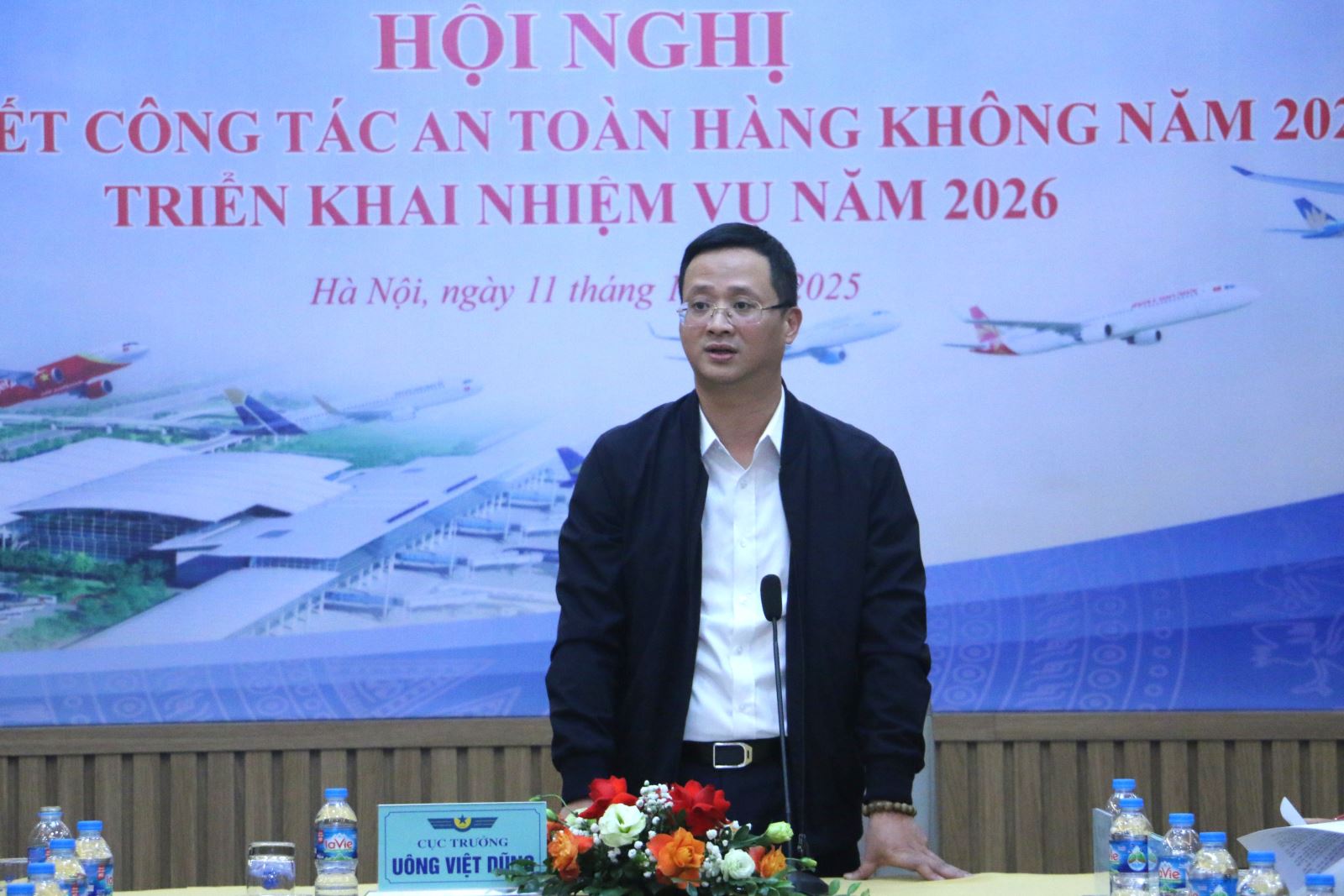
Director General of the Civil Aviation Authority of Vietnam, Uong Viet Dung delivered the concluding remarks at the conference.
In order to sustain the achievements and move toward a modern, safe, and sustainable aviation sector, Mr. Uong Viet Dung called on agencies and units to closely coordinate in developing guiding documents for the implementation of the Law on Civil Aviation, thereby creating a clear legal framework aligned with practical conditions in Vietnam and ICAO standards, promoting sustainable development and deep international integration; strengthen the dissemination of legal information and improve knowledge about aviation safety; maintain high safety monitoring indicators and capabilities; focus on building and developing highly qualified human resources according to ICAO standards; develop air transport capacity; expand the size of the aircraft fleet in accordance with capacity, infrastructure and safety supervision; expand cargo transport capacity, scale and international flight network.
“The Civil Aviation Authority of Vietnam will continue to stand alongside airlines, airports, air traffic control units and air service providers, in building a safe, modern, transparent, integrated and sustainable aviation environment,” Dung emphasized.