On December 11th, 2025, in Hanoi, the Ministry of Construction held a meeting of the Advisory Council to evaluate and approve the Science and Technology Task "Research on the scientific and practical basis for building a National Architectural Database," led by the National Institute of Architecture. Mr. Le Minh Long, Deputy Director of the Department of Science, Technology, Environment and Construction Materials, chaired the meeting.
Presenting the research results to the Council, M.Sc. Nguyen Quoc Hoang - Task Leader - explained the reasons and the necessity of studying the scientific and practical basis for building the National Architecture Database. He also stated that the research was conducted to establish a scientific and practical foundation for designing and operating a unified National Architecture Database, ensuring that data components, technical models, governance mechanisms, and the legal framework are fully and clearly defined. This task is of significant importance for standardizing and providing architectural data to support state management, planning, heritage preservation, and promoting the digital transformation of the construction sector in line with the orientation of the National Digital Transformation Strategy by 2025, with a vision toward 2030.

M.Sc. Nguyen Quoc Hoang - Task Leader presented the research results to the Council.
According to M.Sc. Nguyễn Quốc Hoàng, the research scope covers the entire architecture data system from the provincial and city levels to the national level, focusing on addressing the issues of dispersed, unsynchronized, and non-standardized data according to a unified model. The research objects include: the national architecture database system; the scientific basis for information and database management; the practical basis through analysis of domestic and international architecture data models; as well as technological requirements and operational solutions for management and policy planning purposes.
To carry out the contractual tasks, the research team applied various scientific methods to survey the current state of architecture data management at the local level, comparing it with international experience and advanced database models worldwide. Based on this, the team developed an overall picture of the current status of national architecture data, proposed an open and flexible data model, ensuring integration with construction sector data systems, as well as synchronization with the government’s shared data.
Upon completion of the project, the research team recommends reviewing and supplementing legal documents, regulations, and standards on the collection, storage, management, exploitation, and sharing of data architecture; synchronizing the National Data Architecture/Shared Data Dictionary; issuing guidelines on business processes and responsibilities of agencies providing/updating data; building infrastructure and strengthening security for big data (spatial/image/BIM); developing standard APIs/integration platforms for interoperability and sharing with national and specialized databases; researching the application of AI/ML for data analysis and decision support; training and developing staff and experts in architecture and IT; and building a dedicated team for data standardization and quality control.
At the meeting, the Council’s expert members highly appreciated the research team’s seriousness in carrying out the task according to the schedule and closely following the approved outline.
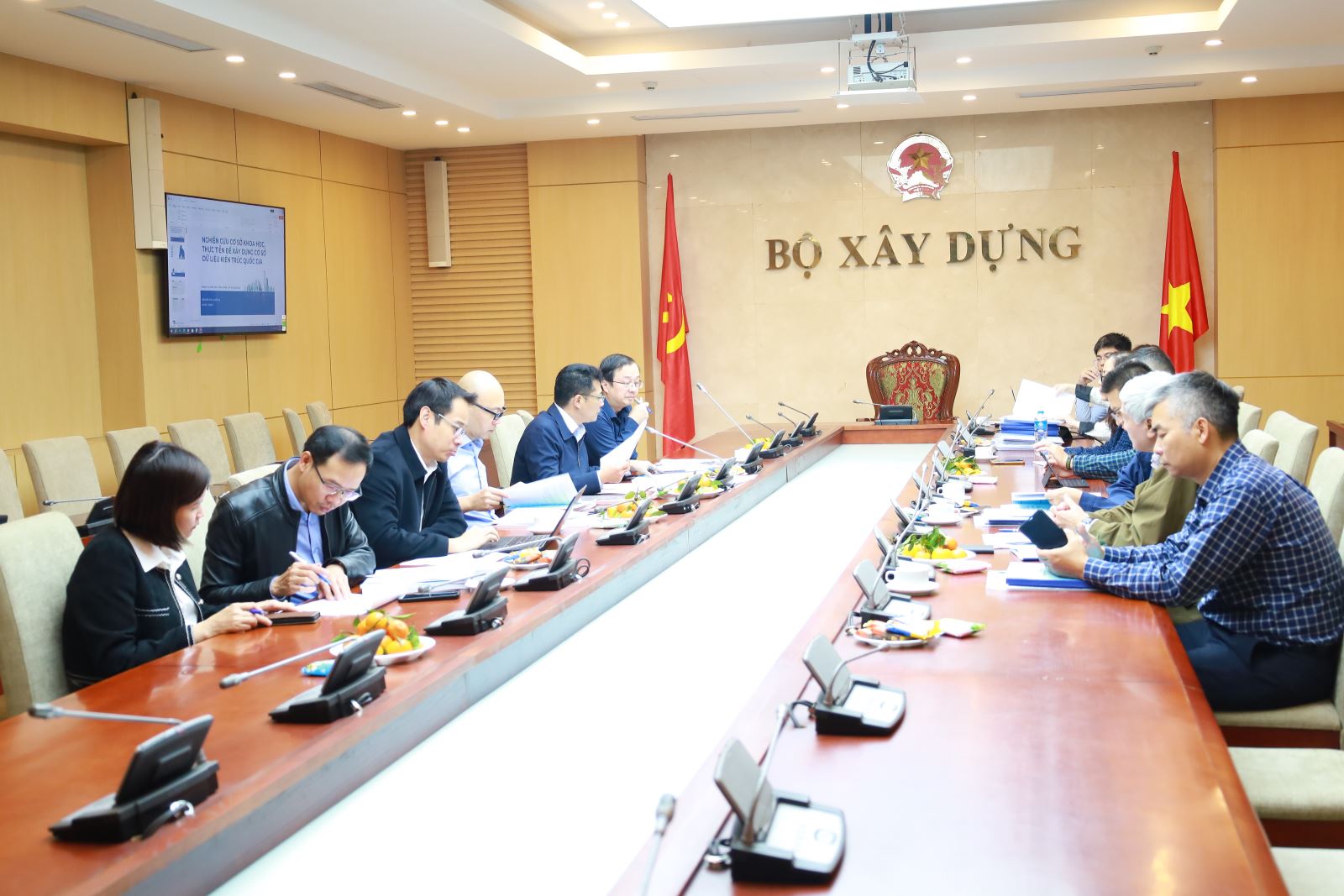
Overview of working.
According to the Review Board, the Summary Report clarified the scientific basis for the formation of the National Architectural Database; fully updated the new legal regulations in the field of architecture; effectively accessed and analyzed the trends in building and operating modern architectural databases worldwide; and created an important foundation for the Ministry of Construction to implement the next phase of the National Architectural Database Project.
However, the Council also requested the research team to further refine several aspects, particularly clarifying the mechanisms for managing, operating, and exploiting data; supplementing the assessment of the current state of architectural data digitization; considering proposed priorities in the data digitization roadmap in the field of architecture; and reviewing and correcting some typographical and typesetting errors.
Concluding the meeting, Chairman of the Council Le Minh Long acknowledged and highly appreciated the research team's investment of time and effort in carrying out the assigned tasks, and noted that they had completed the contracted products on time and in full, while ensuring quality.
The Chairman of the Council, Le Minh Long, summarized the feedback from the Council’s expert members, added some additional points, and requested that the research team fully consider these comments, promptly complete the final report and other deliverables of the Task, and carry out the next steps in accordance with regulations.
The Council agreed to vote for the acceptance of the Task, with the result rated as Good