On the morning of January 22nd, a Memorandum of Understanding on cooperation in developing a specialized center for Building Information Modeling (BIM) for railway projects in Vietnam was signed between the Institute of Construction Economics (Ministry of Construction) and the UK Foreign, Commonwealth and Development Office (FCDO).
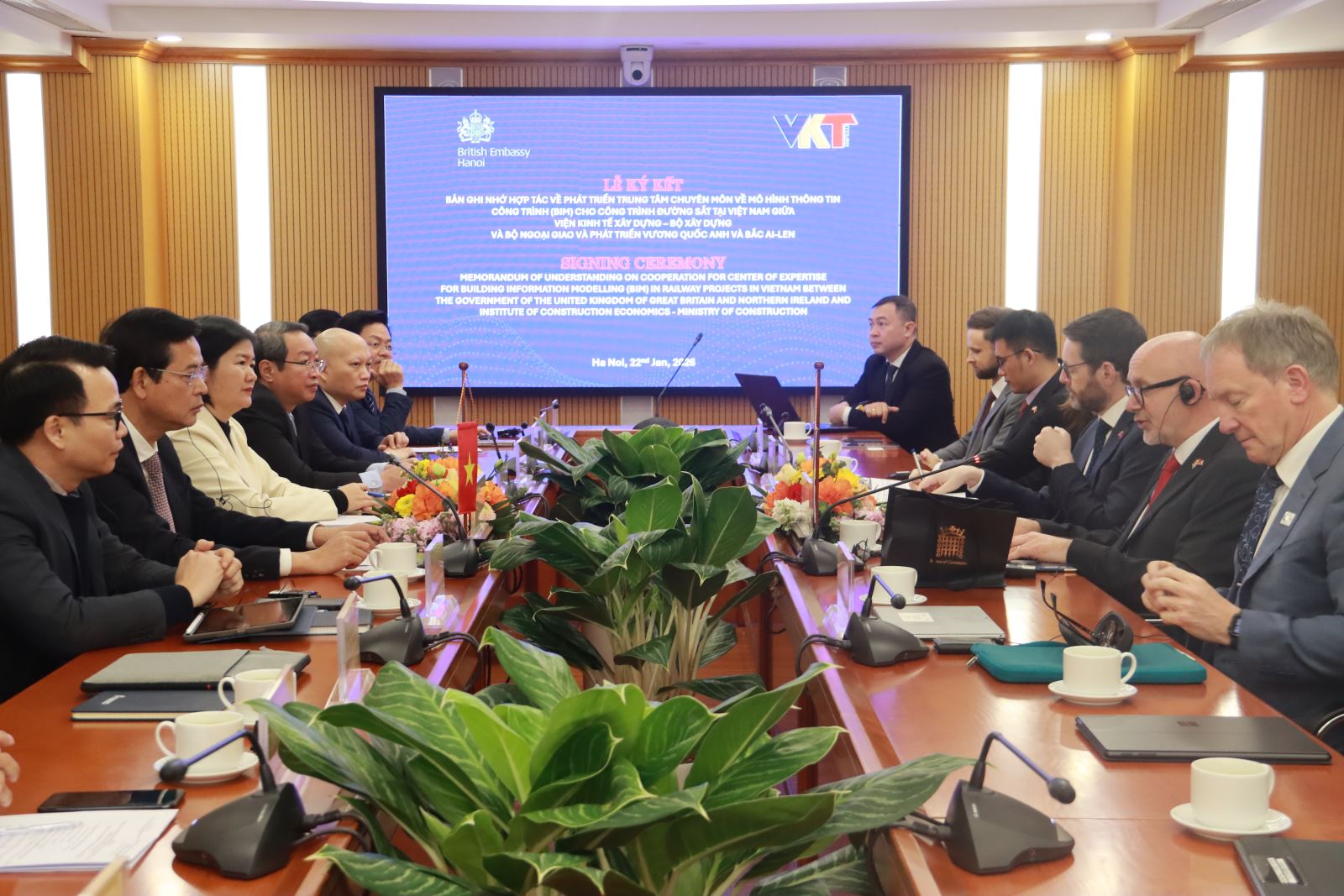
Overview of ceremony.
Attending the signing ceremony, on the UK side were the UK Prime Minister's Trade Envoy Matt Western; the British Ambassador to Vietnam Iain Frew; members of the delegation and international experts.
On the Ministry of Construction side were Deputy Minister Bui Xuan Dung; Director of the Institute of Construction Economics Nguyen Tan Vinh; representatives from the Departments and Agencies: International Cooperation, Planning - Finance, Science and Technology, Environment and Construction Materials; Construction Investment Economics and Management, Vietnam Railways; the Information Technology Center; the Project Management Boards of: Railways, Thang Long; Vietnam Railways Corporation; the University of Transport Technology and representatives from units under the Institute of Construction Economics.
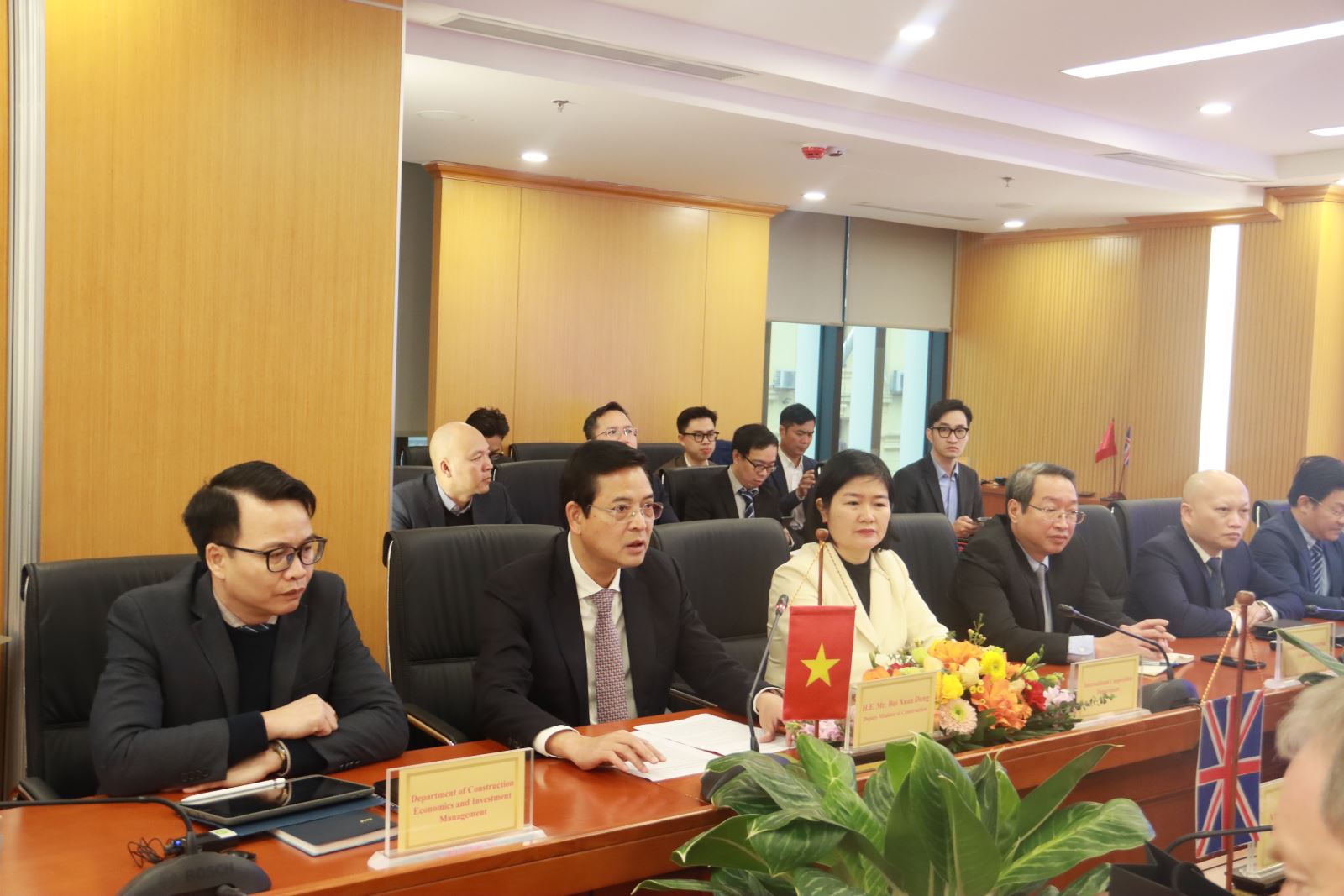
Deputy Minister Bui Xuan Dung spoke at the ceremony.
Speaking at the signing ceremony, on behalf of the leadership of the Ministry of Construction, Deputy Minister Bui Xuan Dung emphasized that the presence of Mr. Matt Western and Mr. Iain Frew at the ceremony not only represents a strong commitment of the UK Government to Vietnam, but also affirms that the Comprehensive Strategic Partnership between the two countries is becoming deeper, more substantive, and more effective.
The Deputy Minister stated that Vietnam is making great efforts to realize its aspiration of becoming a developed country by 2045. Transport infrastructure especially railways has been identified as the “lifeblood” and a key driving force of the economy. Vietnam is entering a preparatory phase for unprecedented large-scale projects, such as the North–South high-speed railway, railway infrastructure projects in the northern region, and urban railway network infrastructure in Hanoi, Ho Chi Minh City, and neighboring provinces. These are projects of high technical complexity, with extremely large total investment and service lifecycles lasting hundreds of years. According to the Strategy for the Planning of Vietnam’s Railway Network up to 2030 and beyond, these projects will be completed by and after 2030.
Appreciating the UK’s many achievements in promoting the application of BIM, particularly in railway projects, the Deputy Minister expressed his hope that this cooperation would be further deepened and would support Vietnam in establishing a Specialized Center for Building Information Modeling (BIM). He also expressed his desire for UK experts to transfer technology and provide training so that Vietnam can fully master the application of BIM in railway projects.
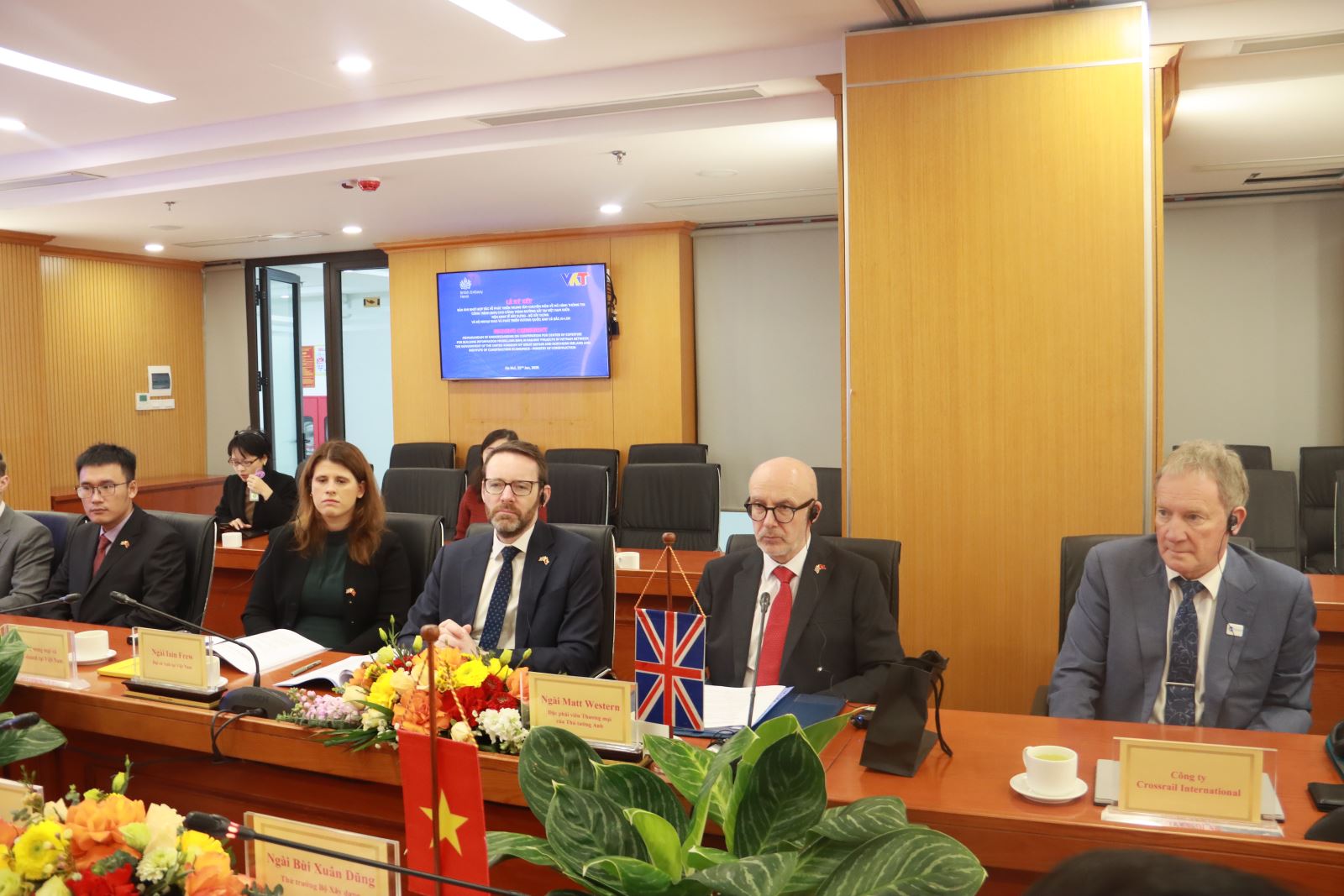
The UK Prime Minister's Trade Envoy Matt Western spoke at the ceremony.
Expressing his sincere appreciation to the Deputy Minister for welcoming the delegation and attending the signing ceremony, the UK Prime Minister’s Trade Envoy, Matt Western, said he was proud to partner with the Ministry of Construction since 2015, when Vietnam began its journey toward the adoption of BIM.
“Today’s signing of the Memorandum of Understanding is the natural outcome of a decade of technical cooperation and mutual trust,” Mr. Matt Western affirmed, noting that the UK’s expertise is most clearly demonstrated by the Elizabeth Line (Crossrail) in London. By developing a “virtual railway” in parallel with the physical railway, the project successfully delivered a 100-kilometer network running through historic foundations and highly complex technical infrastructure systems, with millimeter-level accuracy. This project demonstrates that BIM is not only a tool, but also an essential platform for delivering modern, high-capacity, world-class urban railway systems.
BIM standards currently applied worldwide are designed to ensure that infrastructure is planned, constructed, and managed with absolute digital accuracy. Thanks to UK methodologies, major projects such as the Elizabeth Line have demonstrated that even highly complex railway systems can be build right the first time. BIM acts as a “digital brain,” enabling potential issues to be anticipated and resolved before physical construction begins.
According to Matt Western, Specialized Center for Building Information Modeling (BIM) for railway projects is not just an office, but a bridge of knowledge. The Center would enable UK experts to directly train Vietnamese engineers, thereby ensuring that the national railway network is developed in line with the highest international standards. The application of these digital tools could help Vietnam save up to 20% in construction costs and significantly reduce waste, while also supporting the country in meeting its Net Zero environmental commitments.
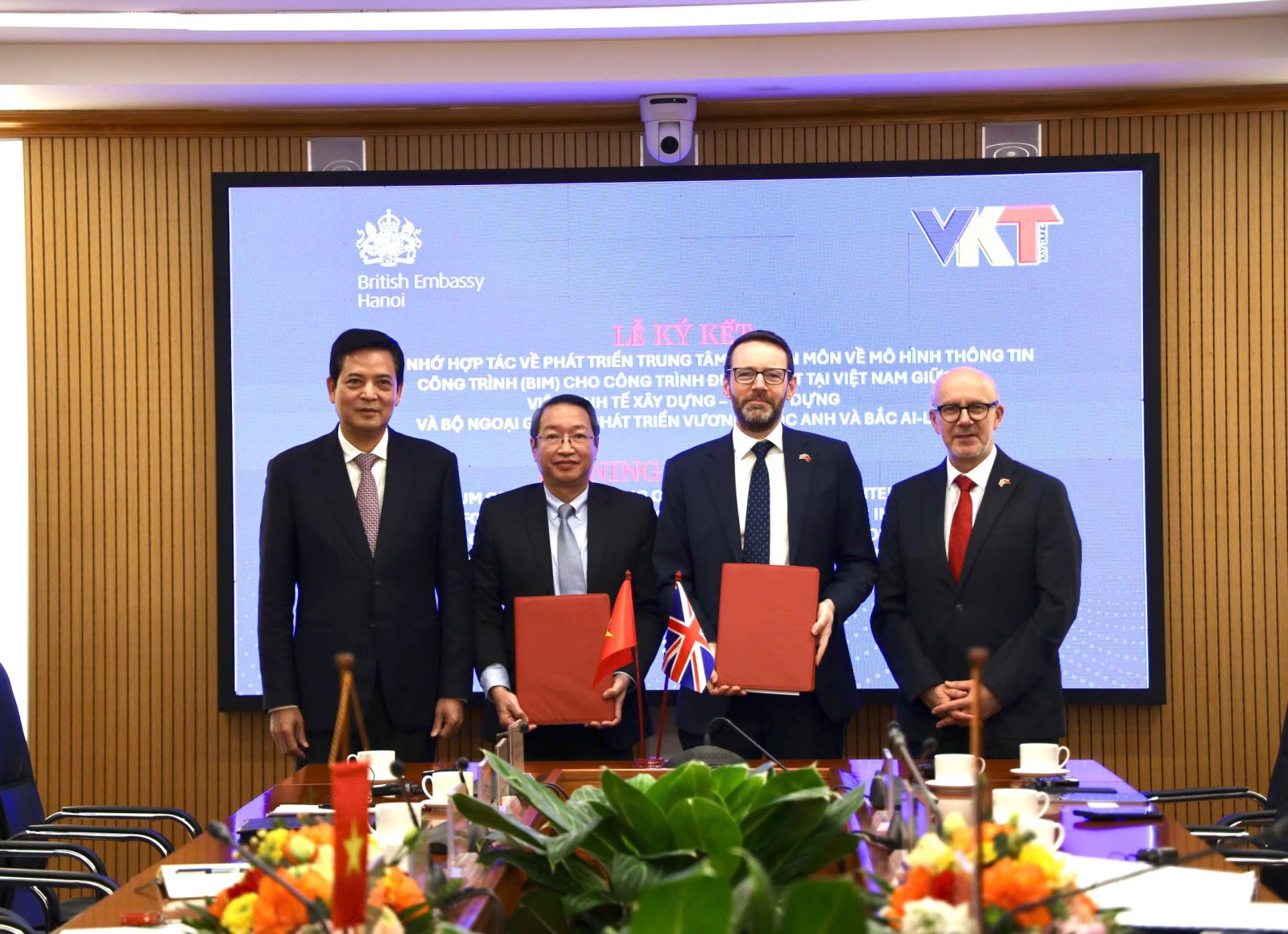
Director of the Institute of Construction Economics Nguyen Tan Vinh and British Ambassador to Vietnam Iain Frew signed and exchanged a Memorandum of Cooperation on the development of a specialized center for Building Information Modeling (BIM) for railway projects in Vietnam, in the presence of Deputy Minister Bui Xuan Dung and the UK Prime Minister's Trade Envoy Matt Western.
In the presence of Deputy Minister Bui Xuan Dung and the UK Prime Minister’s Trade Envoy, Matt Western, along with representatives of agencies and units of the Ministry of Construction and the British Embassy, the Memorandum of Understanding on cooperation in developing a Specialized Center for Building Information Modeling (BIM) for railway projects in Vietnam was officially signed by Mr. Nguyen Tan Vinh, Director General of the Institute of Construction Economics, and Mr. Iain Frew, British Ambassador to Vietnam. This Memorandum serves as the foundation for the two sides to effectively implement their cooperation program in the coming period.