On the afternoon of August 28th, Deputy Minister Nguyen Danh Huy met with the leaders of Hai Phong regarding the deployment of the Lao Cai - Hanoi - Hai Phong railway project on its segment passing through the city.
At the meeting, the consulting team presented the report of the project’s feasibility, which includes several adjustments compared to the previous pre-feasibility scheme. Specifically, the proposed adjustments concern the alignment of the railway at Nam Hai Phong station; Hai Duong Nam station; the branch to Lach Huyen Port; and the segment from Hai Duong to Hai Phong.
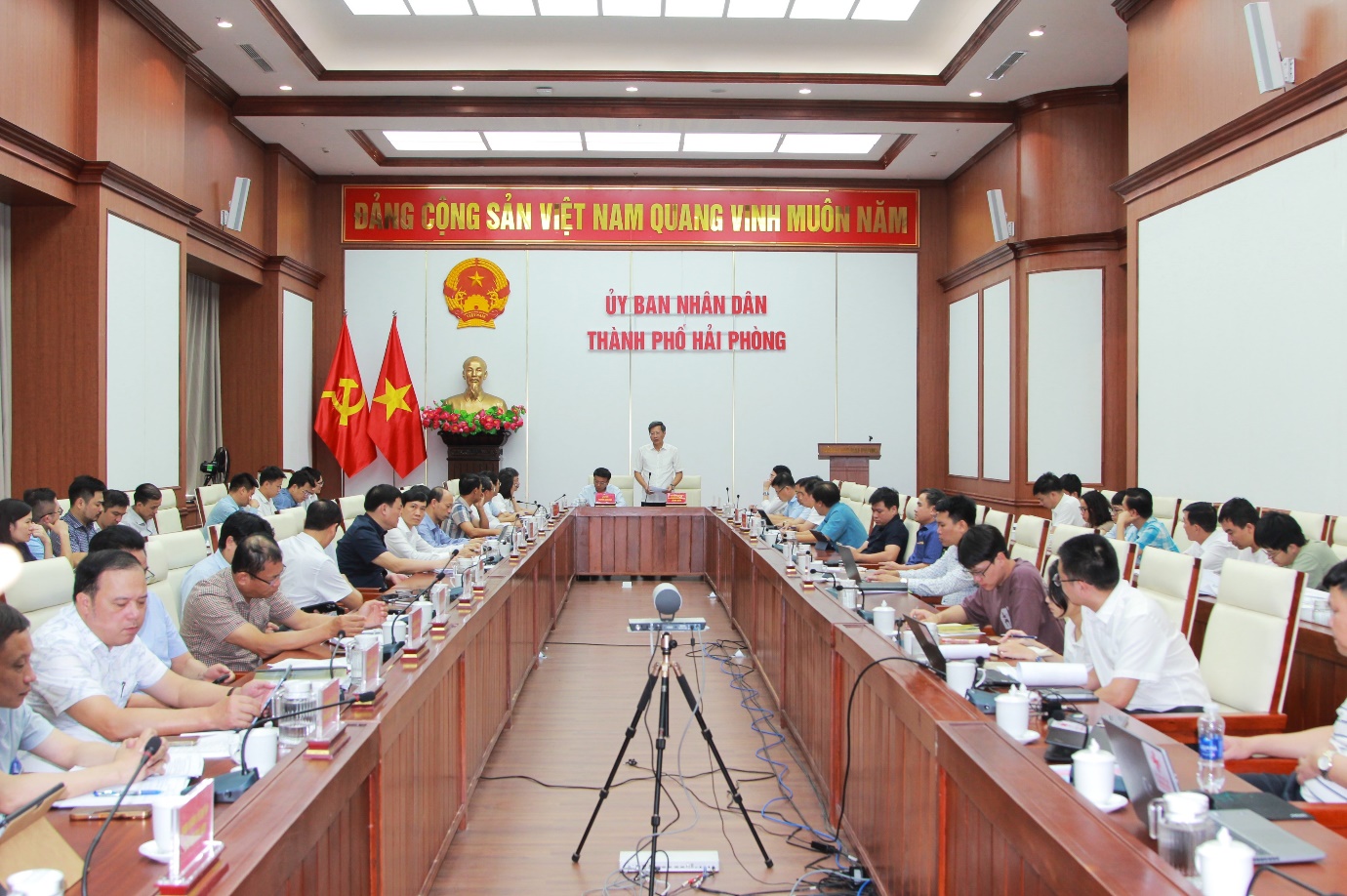
Overview of the working session
According to the consultant, in the pre-feasibility scheme, the Nam Hai Phong station was planned south of the expressway. However, this location shows many constraints: the station is sandwiched between the expressway and the parking yard, which makes passenger convenience lower and reduces freight attractiveness. The capacity of reception/dispatch tracks and engine-movement tracks is insufficient to meet future transport growth.
Under the proposed scheme, Nam Hai Phong station would include three passenger platforms, five tracks for passenger reception/dispatch, 16 tracks for freight reception/sending and engine movements, with an effective length of 850m. It also proposed three freight tracks and one marshalling track. Additionally, one locomotive workshop and one comprehensive maintenance workshop would be arranged.
This scheme aims to avoid interferences between passenger transport and freight in the long term, and the unmatched connection between Nam Do Son branch and the main Hanoi - Hai Phong line.
Regarding Hai Duong Nam station, the pre-feasibility phase revealed several issues: the station has its main track close by, it lies adjacent to the expressway, and the freight yard layout is not reasonable for functional needs.
To address this, the consultant recommends optimizing the pre-feasibility scheme and also studying the option of relocating the station westward without changing the pre-feasibility alignment, as well as the option of straightening the station at Hai Duong Nam.
The consultant proposes the alignment straightening at Hai Duong Nam station, with six reception/dispatch tracks, one standby track, effective length 850m, comprising one basic station and one island station. The freight yard will have two freight tracks and one marshalling track.
According to the pre-feasibility plan for Nam Dinh Vu station and the Dinh Vu branch, the branch runs close to a chemical zone which poses fire-explosion risk; also, the minimum curve radius at the location crossing AH14 was designed at 250m while the design speed is 80 km/h. According to Railway Design Standards for Class III, IV, the minimum radius must be 300 m (corresponding to speed limit 40 km/h). Using 250m not only fails to meet standards but also creates maintenance difficulties, causing wear and rapid rail damage.
Thus, they recommend adjusting the curve radius at the AH14 crossing in the pre-feasibility plan from 250m to 300m to ensure technical requirements and facilitate operations and maintenance. The Dinh Vu branch would avoid the chemical zone, run along the west side of Dinh Vu Industrial Park, then after crossing AH14, turn northwest to Nam Dinh Vu station. Nam Dinh Vu station would be elevated. The branch length is 2.64 km shorter than the pre-feasibility scheme, saving construction investment.
In addition, the consultant also proposes that the segment between Hai Duong Nam station and Nam Hai Phong station (length 47.5 km) is forecast to have significantly increased transport volume compared to the pre-feasibility scenario, so they propose designing an additional passing station between the two stations. Binh Giang station, less than 7 km from Hai Duong Nam station, under the principle of concentrating freight, is recommended to be changed from a freight station to a passing station, with freight handling concentrated at Hai Duong Nam station.
During the meeting, representatives of Hai Phong’s departments and agencies gave feedback on the feasibility study report.
According to the Hai Phong Department of Construction, major changes to the alignment or station locations should not be made; instead, the pre-feasibility scheme should be optimized, because prior studies have basically addressed socio-economic development issues.
So far, Hai Phong city has completed the benchmark-staking for the main line, branches and stations. The city is implementing 14 resettlement areas (11 zones west, 3 zones east). The Department of Construction approved one project in the east and intends to complete appraisal in September 2025. In the western area of Hai Phong, appraisal of five resettlement zones has been completed, and one zone is ready for implementation.
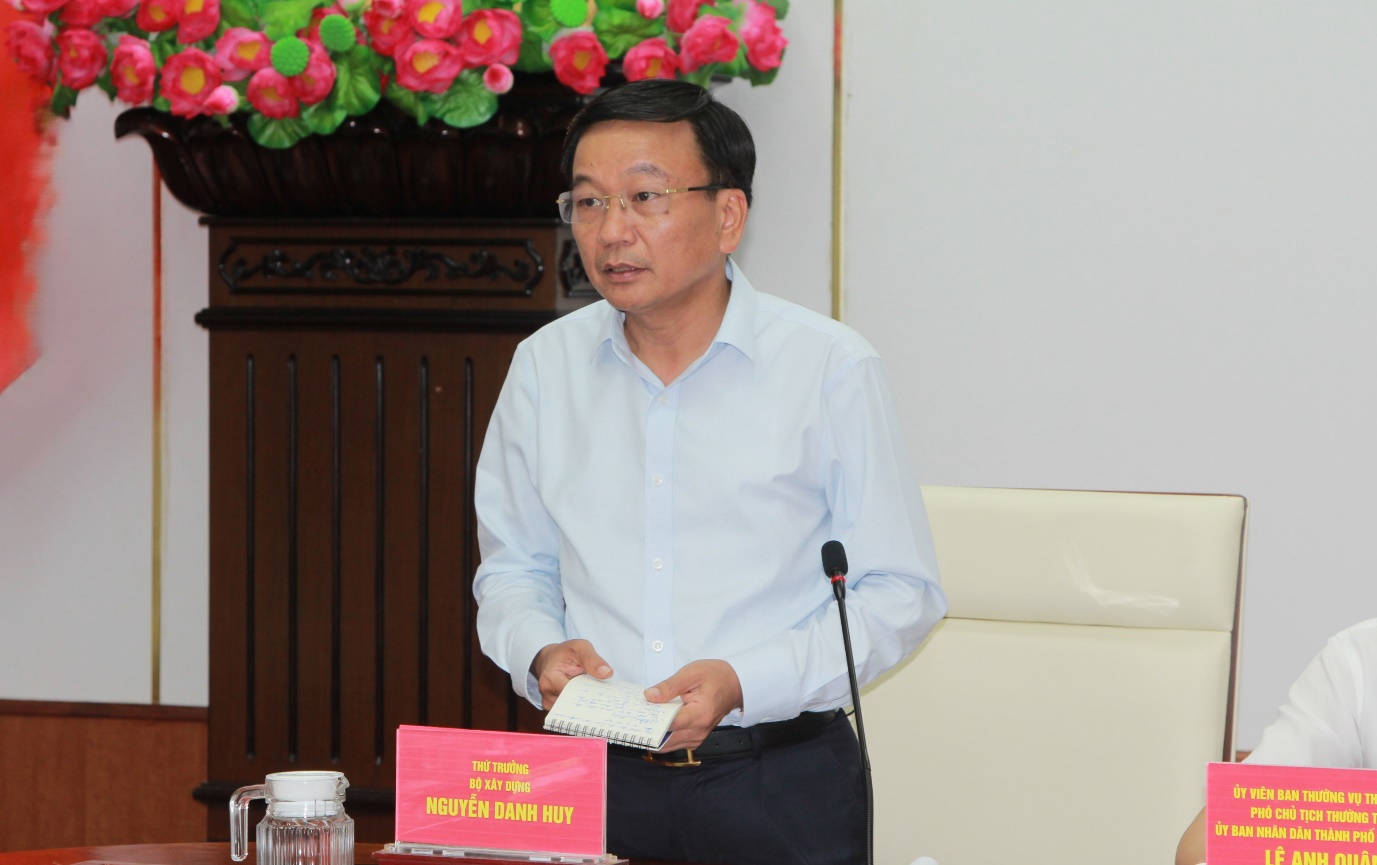
Deputy Minister Nguyen Danh Huy delivered the concluding remarks of the working session.
Deputy Minister Nguyen Danh Huy concluded at the meeting by acknowledging Hai Phong’s efforts in site-clearance and resettlement zone deployment for the railway project. He and the Standing Vice-Chairman of Hai Phong People’s Committee, Le Anh Quan, agreed on some items to finalize the feasibility study. Among them: limit changes to the main and branch alignments; any further changes must stem from rail-specialty technical requirements or further studies on planning, spatial planning and functional zonings.
For the Nam Hai Phong station, the original plan south of the Hanoi-Hai Phong expressway will remain. At the same time, study elevating the Dinh Vu station to reduce construction and operation costs.
Deputy Minister Ngyen Danh Huy tasked the Ministry’s agencies to actively coordinate with Hai Phong’s departments, sectors and locality to implement required items and find the optimal plan for the Ministry to submit to the competent authorities in the near future.