VNĐ3.66 trillion (US$146 million) will be invested into the expansion of Hà Nội-Bắc Giang Expressway this year.
The expressway starts at the National Highway 31 interchange in Bắc Giang Ward of the northern province Bắc Ninh, and ends at the Phù Đổng Bridge in Hà Nội with a total length of 45.2km, of which 38.23km running through Bắc Ninh Province.
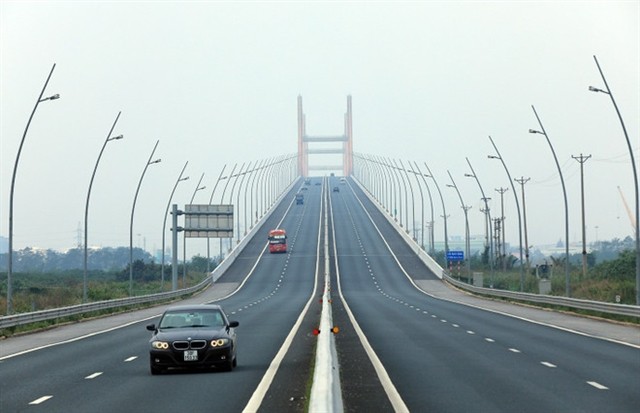
A bridge on Hà Nội-Bắc Giang Expressway. — VNA/VNS Photo
The entire route currently has 16 interchanges with expressways, national highways and major transport axes; five bridges on the main alignment; 13 overpasses at interchanges; three rural bridges; and 31 underpasses for local traffic, with twenty-seven located in Bắc Ninh.
The Bắc Giang–Phù Đổng Bridge section was upgraded and expanded to four lanes and put into operation in 2016 under the Việt Nam expressway standard with a design speed of 100km per hour.
However, the route has many closely spaced interchanges. In particular, on the section from Như Nguyệt Bridge to Phù Đổng Bridge, motorbikes travel on the emergency stopping lane, meaning the maximum operating speed is only 90km per hour, failing to meet expressway standards.
The project consultant, Hà Nội–Bắc Giang BOT Investment JSC, proposed several options to upgrade and expand the expressway.
Analysis showed that expanding the route to six lanes would be the most suitable option in terms of actual traffic volume, land clearance conditions, capital mobilisation capacity, and implementation progress under the public-private partnership model. Expansion to eight lanes was deemed financially unfeasible.
Under the proposed plan, the section from National Highway 31 in Bắc Ninh Province, to Phù Đổng Bridge in Hà Nội, with a total length of 45.22km, would be expanded to six motor vehicle lanes with a design speed of 100km per hour.
The project would expand the median strip and include full gantry systems, intelligent transport systems, weigh stations, expanded interchanges, overpasses, underpasses and other necessary works
If a closed-toll system is applied, an additional VNĐ400 billion ($16 million) would be required for toll operation buildings and equipment.
At a recent working session with the Ministry of Construction on investment plans to upgrade and expand the expressway, Bắc Ninh Party Secretary Nguyễn Hồng Thái stressed that the province’s policy is to expand the route in a manner that maximises benefits for local residents while strengthening competitiveness and development momentum.
“It was necessary to continue a comprehensive assessment of key economic indicators such as investment attraction, budget revenue growth and export promotion to ensure the project’s effectiveness,” Thái said.
He therefore proposed that the Ministry of Construction conduct an overall review of the national transport system, particularly the completion of Ring Roads No. 4 and 5, and expressway connections.
On that basis, he assigned the provincial People’s Committee to continue detailed discussions with investors to study and agree on the investment plan and scale for the Hà Nội–Bắc Giang Expressway, and to report to the Ministry of Construction and the provincial Party leadership as soon as possible.
Meanwhile, deputy Minister of Construction Lê Anh Tuấn said that, in line with the Prime Minister’s direction on decentralisation and delegation of authority, projects currently managed by the ministry are expected to be handed over to local authorities.
So, the ministry will study and consider implementation options proposed by Bắc Ninh Province.
Regarding toll collection, he said relevant authorities should continue coordinating with Bắc Ninh Province to consider the most optimal option in accordance with the law.
The deputy minister affirmed that the Ministry of Construction and related agencies would continue to accompany the province during project implementation, particularly in providing guidance on technical management and participating in consultancy and evaluation work.
The ministry will continue reviewing, planning and finalising technical documentation for submission to the province for consideration and agreement.