On August 21st, 2025, in the framework of Vietnam Water Week 2025, a thematic workshop titled “Vietnam Water Sector in the New Era: Challenges and Opportunities” was held in Hanoi. The event was organized by the Vietnam Water Supply and Sewerage Association (VWSA) and attracted more than 200 delegates, including managers, domestic and international experts, scientists, and representatives of water supply, drainage, and wastewater treatment companies.
In his opening speech, Mr. Nguyen Ngoc Diep, Chairman of VWSA, emphasized the vital role of water in people’s lives and in the socio-economic development of the country. He noted that while the Vietnamese water sector enters 2025 with high aspirations, it is also facing significant challenges: increasingly severe climate change, rapid urbanization, declining water resources, unsynchronized infrastructure, and new demands for service quality and environmental protection.
With the strong interest and participation of numerous experts, scientists, and businesses, Mr. Nguyen Ngoc Diep expressed his hope that the delegates would actively exchange and discuss in order to fully identify the difficulties and challenges as well as the opportunities of Vietnam’s water sector in the new era, thereby proposing solutions and policy recommendations to further improve and complete the regulatory framework for the sustainable development of the water sector in Vietnam.
During the workshop, Mr. Nguyen Minh Duc from the Department of Construction Infrastructure (Ministry of Construction) presented statistics on the current state of Vietnam’s water sector: by 2025, there are about 250 urban water companies nationwide; among them, 105 have converted from one-member limited liability companies to joint-stock companies, while about 8 still operate as one-member LLCs. The country has around 1,000 clean water plants in urban and peri-urban areas with a total capacity of 13.2 million m³/day; the rate of urban population served with clean water is 94%. In rural areas, there are roughly 18,000 centralized water systems, about 10 million household-level water connections, and 92.5% of rural residents use hygienic water, of which nearly 54% meet the clean-water standard QCVN 02:2009/BYT of the Ministry of Health.
For drainage and wastewater treatment, the nationwide wastewater collection rate of urban drainage systems has now reached approximately 64%. About 70% of households are connected to urban drainage networks. Across the country, 83 urban wastewater treatment plants are in operation in more than 50 cities. The total designed treatment capacity of these plants is about 2.064 million m³/day, with an actual operational capacity of around 1.063 million m³/day.
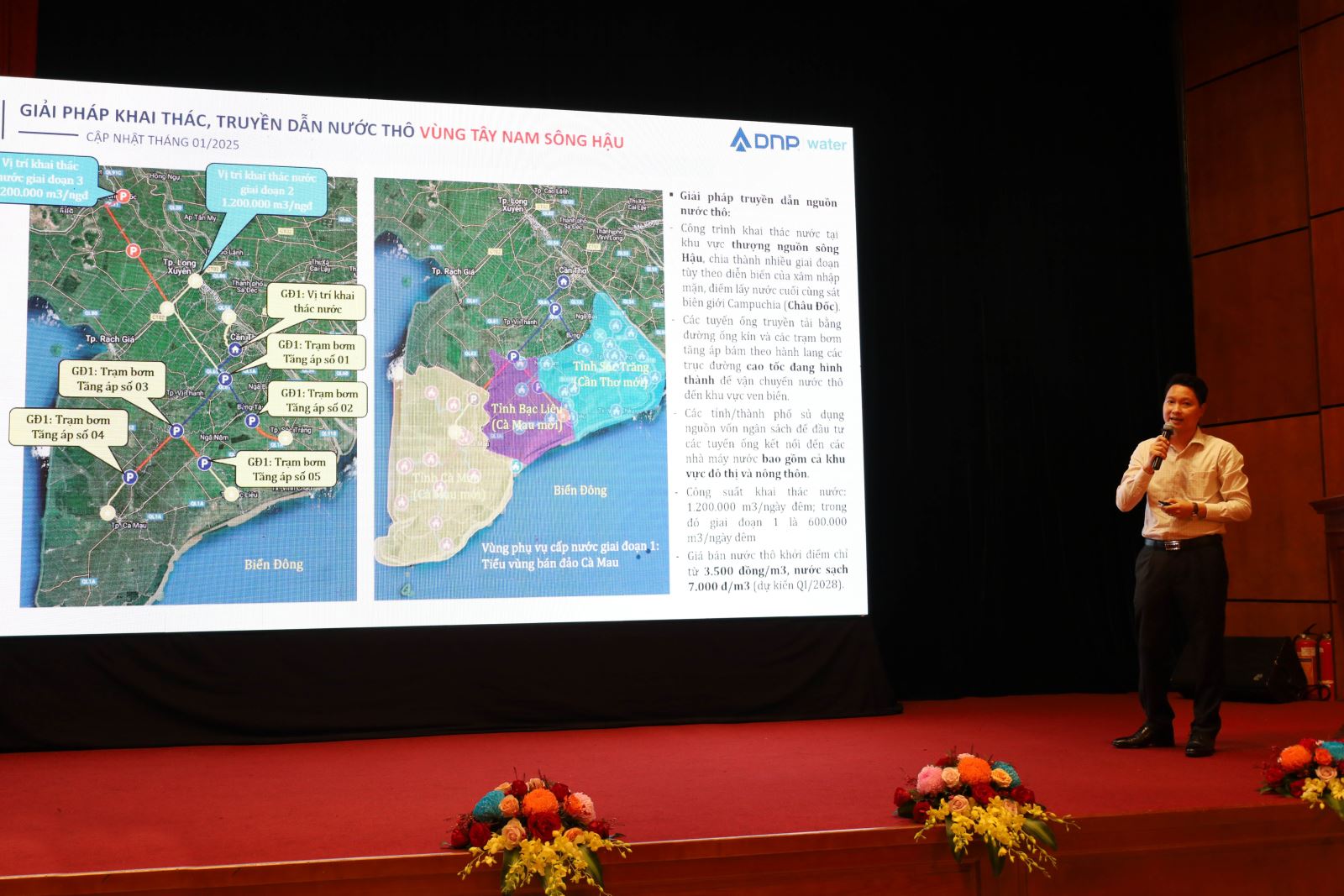
An expert presented a report at the workshop.
“In addition, the information systems and databases for water supply, drainage, and wastewater treatment remain incomplete, making it difficult to assess the situation, prepare planning, set orientations, mobilize investment, and carry out state management. Water supply and drainage infrastructure lacks sustainability and efficiency; service quality and operational management still have many limitations. The issuance of clean water tariffs faces numerous challenges, while drainage and wastewater treatment service fees remain low, limiting investment mobilization. State management of water supply and drainage is still overlapping and not yet unified,” Mr. Nguyen Minh Duc emphasized.
Based on the identified challenges and opportunities, the Ministry of Construction is proposing a Water Supply and Drainage Law. Strategic orientations include: investing in drainage infrastructure in a basin-wide, synchronized way to address flooding and handle wastewater; combining state budget resources with social (private) capital via public-private partnerships for wastewater treatment plants; committing to a 20-30 year state budget allocation to support basic wastewater treatment; allocating state funds based on a percentage of GDP and creating policies to mobilize social investment; and ensuring that the legitimate interests of both water companies and consumers are protected. The strategy also involves regulating the relationships among the state, water utilities, and residents and ensuring fair service provision by region; integrating water supply and drainage service management to improve investment and environmental protection efficiency.
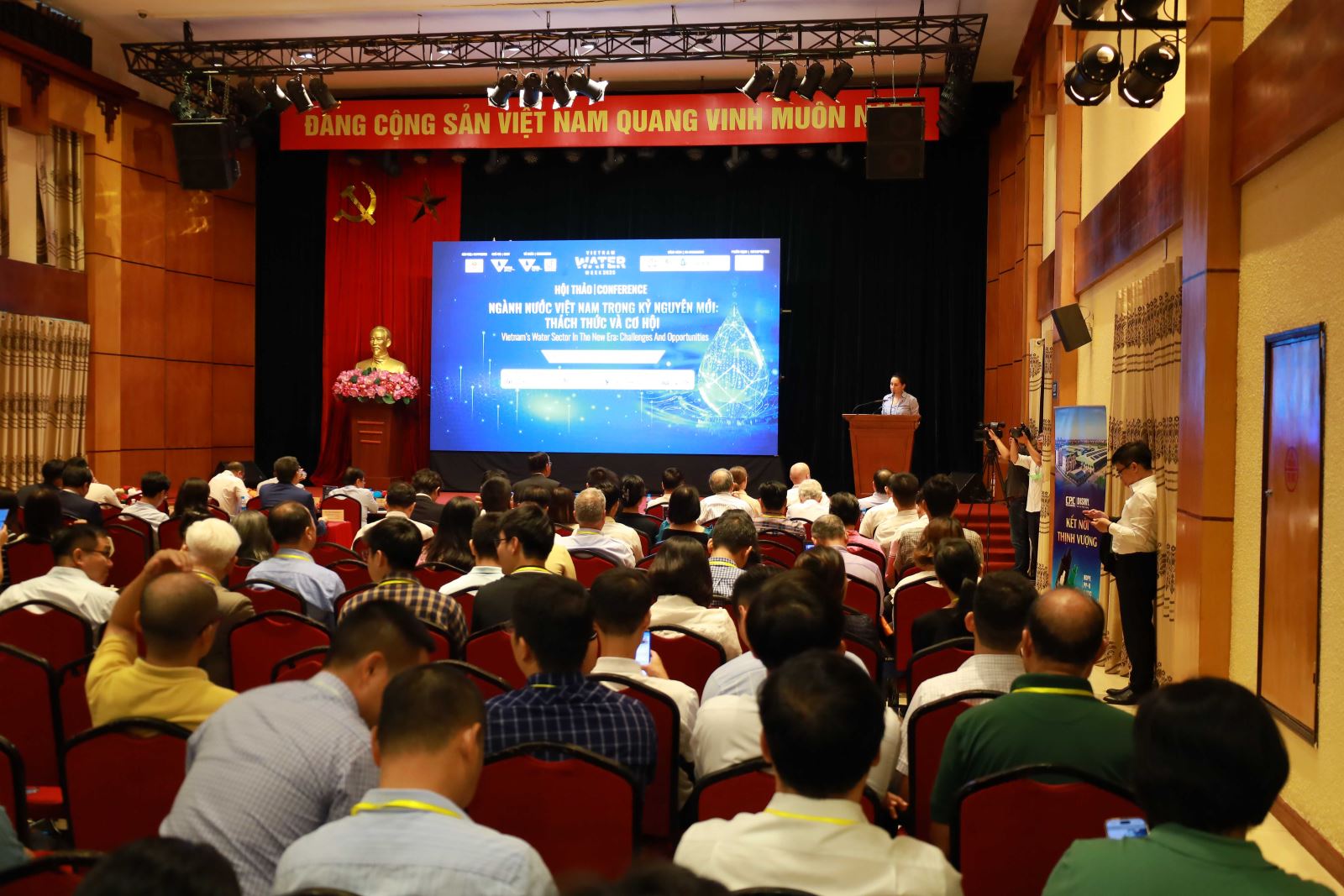
Overview of the workshop.
A keynote presentation at the workshop titled “Regional Water Supply - Sustainable Solutions Adapting to Climate Change in the Mekong Delta” was given by Mr. Leu Manh Huy, CEO of DNP Water Investment Joint Stock Company. He emphasized the need to exploit natural advantages and scientific progress to build sustainable water supply solutions adapted to climate change in the Mekong Delta. These include taking raw water from upstream regions, transporting it through closed pipelines to downstream water treatment plants, and optimizing existing infrastructure. The plan envisions private investment in pumping stations and main pipelines, while the state will invest in the connection components to areas of water consumption.
Dr. Tran Van Huy, Head of the International Project at WaterAid Australia, shared Australia’s experience using Artificial Intelligence (AI) to make the water sector smarter. He highlighted that AI is no longer futuristic: many practical applications already exist, but with great benefits come risks. Human roles remain essential in critical thinking and oversight, and environmental impacts of AI (e.g., data centers’ water and electricity consumption) must be carefully considered.
Throughout the workshop, domestic and international experts, policymakers, and businesses actively discussed a variety of topics: planning and regulatory challenges in water and drainage projects, financing for water and sanitation services, using nature-based infrastructure, mobilizing investments, promoting scientific technology and digital transformation in water production and distribution, IT applications in the water sector, boosting creditworthiness to access international funding (such as the model from BIWASE), and raising capital for SMEs and households to improve access to clean water and sanitation in Vietnam.